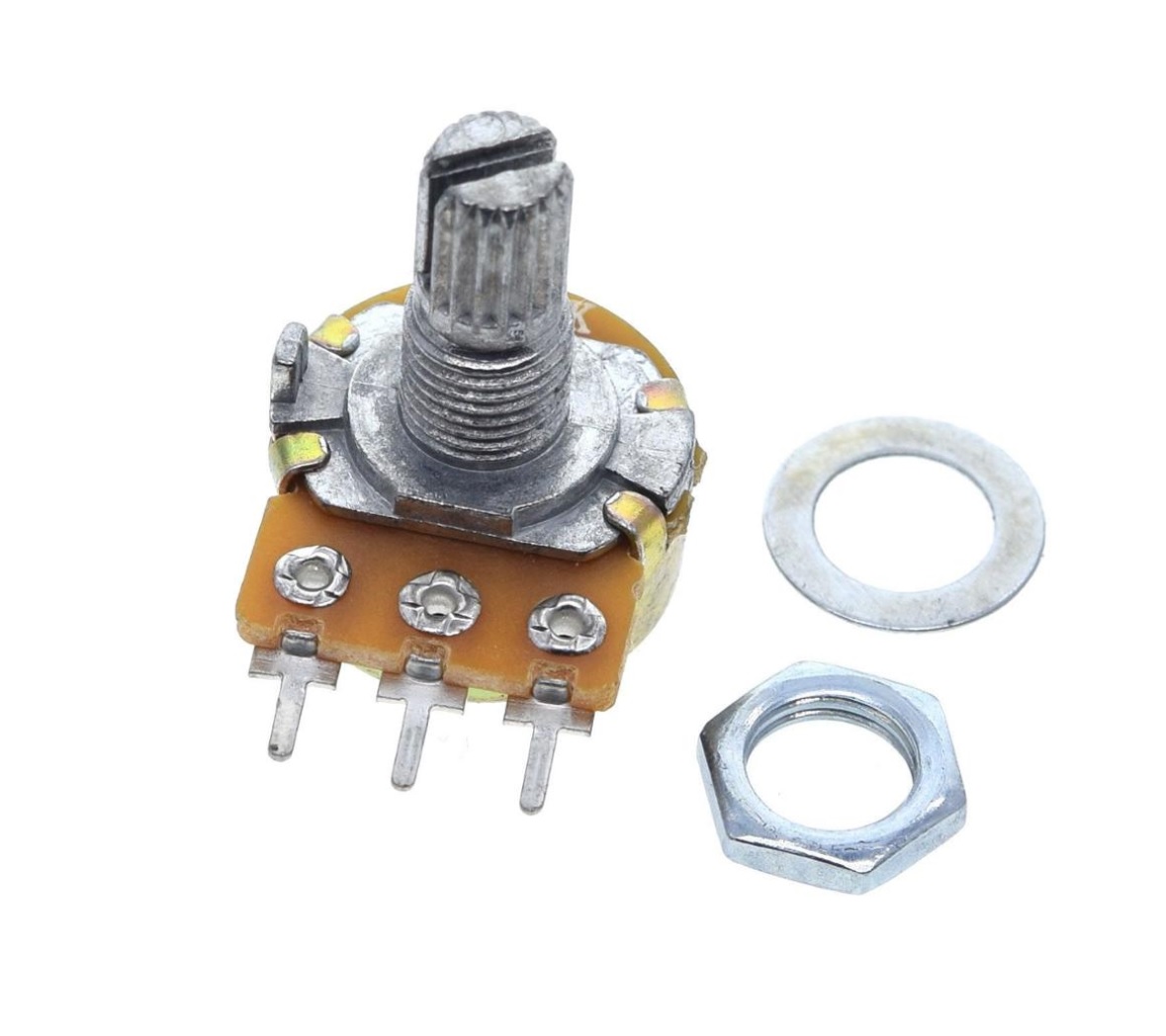
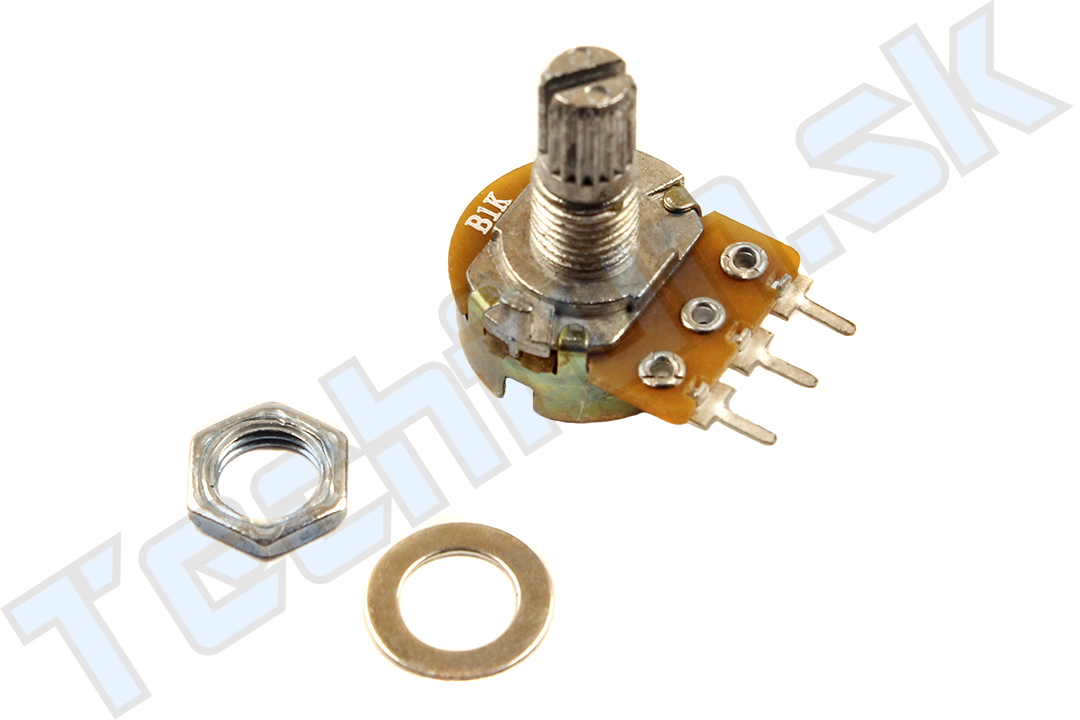
A rotary potentiometer is a passive resistive component designed for analog input to microcontrollers and Arduino platforms. It serves for manual regulation of voltage or resistance in electronic circuits. The package includes mounting nut and washer.
Technical specifications
Resistance types: B1K, B10K, B50K, B100K, B500K
Characteristics: Linear (B) and logarithmic (C)
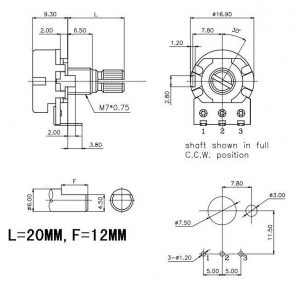
Shaft diameter: 6 mm
Rotary type with mechanical detent
Mounting accessories included: nut, washer
Usage and applications
Analog inputs for Arduino, STM32, ESP and other microcontrollers
Volume control element in audio applications
Brightness, temperature and other parameter adjustment in projects
Mode or setting selection in interactive systems
Additional materials
An additional shaft or knob can be purchased for the potentiometer. Details can be found in section kryt.
Operating notes
The choice of appropriate resistance depends on the application: lower resistances (B1K) are used in low-impedance circuits, higher resistances (B500K) in high-impedance applications. Logarithmic characteristic (C) is chosen for applications involving human perception (sound volume), linear characteristic (B) for precise digital measurements.
Additional information
Weight
7 g
FAQ
What is the difference between linear and logarithmic potentiometers?
A linear potentiometer (B) changes resistance uniformly with shaft rotation. A logarithmic potentiometer (C) has a characteristic adapted to human perception — used for sound volume or brightness, where perception is not linear.
Which resistance should I choose for my project?
The choice depends on circuit impedance and output voltage. Lower resistances (B1K, B10K) are used in low-impedance circuits with high current. Higher resistances (B100K, B500K) in high-impedance applications. Typically B10K or B100K is used in Arduino projects.
Can a potentiometer be connected directly to Arduino?
Yes. The outer terminals are connected to the supply voltage (5V) and ground, the middle terminal to an analog input (A0–A5). Arduino then reads the value 0–1023 through the analogRead() function.
What is the maximum current through a potentiometer?
A potentiometer is a pure resistor without active components. Maximum current depends on the application — typically calculated using Ohm’s law (I = U/R) and is not precisely specified without a specific datasheet. During normal operation in Arduino projects, the current is minimal (tens of μA).
Can I use a potentiometer in digital circuits?
No — a potentiometer is purely an analog component. If you need a digital output, you must use an ADC converter (analog-to-digital converter) on the microcontroller or an external chip.
What if the potentiometer starts crackling or shows jumps in value?
Crackling and jumps usually indicate contamination of the contact track or mechanical wear. A short-term solution is to rotate the shaft multiple times in both directions. For long-term applications, consider replacement.
3 reviews for Potentiometer Various Types B1K to B500K
Rated 5 out of 5
Heureka overený zákazník –
Plusy: Cena
Mínusy:
Celkovo:
Rated 5 out of 5
Heureka overený zákazník –
Plusy:
Mínusy:
Celkovo: Štandard dobrý prvok
Rated 5 out of 5
szilagyiszilard1969 –
I received a perfectly flawless product. I recommend to everyone.
Používame cookies na zlepšenie vášho zážitku, analýzu návštevnosti a zobrazovanie relevantného obsahu. Môžete prijať všetky, odmietnuť nepodstatné alebo si spravovať svoje preferencie.
Predvoľby cookies
Vyberte, ktoré kategórie cookies povoľujete. Túto voľbu môžete kedykoľvek zmeniť cez tlačidlo Nastavenia cookies.
Nevyhnutne potrebné
Potrebné pre správne fungovanie webu. Nedajú sa vypnúť.
Funkčné
Pamätajú si vaše preferencie (jazyk, región, rozloženie).
Analytické
Pomáhajú nám pochopiť, ako návštevníci používajú web.
Marketingové
Slúžia na zobrazovanie personalizovaných reklám a meranie kampaní.
This site is registered on wpml.org as a development site. Switch to a production site key to remove this banner.



Heureka overený zákazník –
Plusy: Cena
Mínusy:
Celkovo:
Heureka overený zákazník –
Plusy:
Mínusy:
Celkovo: Štandard dobrý prvok
szilagyiszilard1969 –
I received a perfectly flawless product. I recommend to everyone.